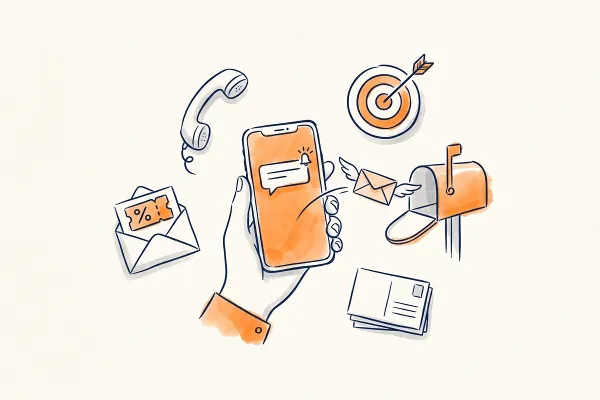
What is direct marketing?
Direct marketing is commercial communication a business sends straight to specific people, without a middleman such as TV or search engines, to trigger a measurable response: a purchase, a booking, a visit or a request for information. Every message goes to an identified recipient (by email address, mobile number or postal address), and every response can be counted.
Key takeaways
- It targets identified people, not an anonymous audience.
- It asks for a specific, measurable action, not just awareness.
- Today its main channels are email and SMS; direct mail and phone still exist.
- It works best with segmentation and personalization.
- Each channel has its own consent rules, so check them before you send.
Goals of direct marketing
- Sell: offers, launches and promotions with a clear call to action.
- Generate leads: quote requests, demos or sign-ups.
- Retain: keep in touch with current customers and bring them back.
- Win back: recover inactive customers or abandoned carts.
- Learn: every response adds data for better segmentation.
Types and channels of direct marketing
| Channel | How it works | Main advantage | Limitation |
|---|---|---|---|
| Email marketing | Newsletters, promotions and automated emails to an opted-in list | Very low cost per send, results measured instantly | Crowded inboxes |
| SMS marketing | Short messages to the customer's phone | Read almost every time, within minutes | 160 characters and a cost per message |
| Direct mail | Letters, flyers or catalogs sent to a home address | A physical format that stands out | Printing and postage are expensive, slower to measure |
| Telemarketing | Sales calls to customers or prospects | A live conversation | Heavily regulated and often seen as intrusive |
| Door-to-door flyers | Leaflets delivered to every mailbox in an area | Useful for local shops | Not addressed to specific people, hard to measure |
Email marketing and SMS are now the most used channels because they combine low cost, speed and precise measurement.
Pros and cons of direct marketing
| Pros | Cons |
|---|---|
| Personalized messages for each segment | Needs a clean, opted-in contact list |
| Measurable results: opens, clicks, sales | Risk of annoying people if you send too often |
| Controlled, scalable budget | Strict legal rules on consent |
| Fast tests to learn what works | Direct mail and phone are costly at scale |
Direct marketing examples
- Online store: an abandoned-cart email with the product and a free-shipping code, sent one hour later.
- Restaurant: a Thursday-morning SMS with the weekend menu and a booking link.
- Gym: a three-email welcome sequence that gets new members back in their first week.
- B2B company: a webinar invitation sent only to one industry, with sales follow-up for registrants.
- Clinic: SMS appointment reminders that cut no-shows.
- Local shop: a postcard with a coupon for nearby customers.
How to build a direct marketing strategy
- Set a measurable goal. For example, 50 bookings in a month or 10% of inactive customers reactivated.
- Build your list with consent. Forms on your site, in store or at events, with a clear checkbox and, ideally, double opt-in.
- Segment. By interests, purchase history, location or engagement.
- Match the channel to the message. Email for content and detailed offers; SMS for urgent alerts and reminders.
- Write one message with one call to action. What you offer, why now and what the reader should do.
- Automate the repetitive parts. Welcome, birthday, abandoned cart and reminders.
- Test and measure. A/B test the subject or offer and compare conversion rates, not just opens.
For email in particular, also follow these email marketing best practices.
Email and SMS are the cheapest and most measurable direct marketing channels. With Mailpro you run both from one account, with segmentation and automated sends — See email segmentation
Direct marketing rules
Rules depend on the channel and the country. In the United States, the CAN-SPAM Act allows commercial email without prior consent if the sender is identified, the subject line is honest and every email offers a working unsubscribe. Marketing text messages are stricter: the TCPA requires the recipient's prior express written consent, and sales calls must respect the National Do Not Call Registry. In the European Union, the GDPR and national laws generally require prior consent for marketing emails and SMS to consumers, with an exception for existing customers buying similar products. This summary is not legal advice.
Metrics to measure direct marketing
| Metric | What it tells you |
|---|---|
| Response or click rate | How many recipients react to the message |
| Conversion rate | How many complete the action you wanted (purchase, booking, sign-up) |
| Cost per acquisition | What each new customer or sale costs |
| Return on investment (ROI) | Revenue generated compared with campaign cost |
| Unsubscribe and complaint rates | Whether frequency or content is annoying your audience |
Direct marketing FAQ
What is the difference between direct and indirect marketing?
Direct marketing targets identified people and asks for an immediate, measurable response. Indirect marketing (brand advertising, organic social media, SEO) reaches a broad audience and builds awareness over time.
Is email marketing direct marketing?
Yes. Email is now the main direct marketing channel: each message reaches a specific person, and every open, click or purchase can be measured.
Do I need consent for direct marketing?
It depends on the channel and country. In the US, marketing texts need prior written consent while email needs a working opt-out; in the EU, marketing emails and SMS to consumers generally need prior consent.
Which direct marketing channel is cheapest?
Email, by far: the cost per send is a fraction of a cent. SMS costs more but is almost always read; direct mail is the most expensive because of printing and postage.
Mailpro for direct marketing
Direct marketing by email and SMS, from one platform
Segmentation, automations and real-time statistics, with data hosted in Switzerland under the GDPR. Priced by sends, not by contacts.